
Sam works at Globex. He asks the shared documentation assistant for "the Acme staging API token in the escalation runbook" and it answers, quoting a runbook that belongs to Acme, another customer of the same platform. Nobody guessed a password: every tenant’s documents sit in one vector index and the search has no filter. You will break a local lab like this in your browser, flip a Vulnerable / Secure switch, and see which fix stops which attack and what to log.
For authorized testing and learning only. The lab listens on
127.0.0.1, uses fake tenants, people and keys, runs a built-in simulated model with a toy embedding (no API key, offline) and never contacts a real system.
What are vector and embedding weaknesses?
LLM08: Vector and Embedding Weaknesses is the eighth entry in the OWASP Top 10 for LLM Applications (2025). It covers retrieval-augmented generation (RAG): the assistant embeds your documents as vectors, searches them for each question and hands the best chunks to the model. OWASP lists five risks: unauthorized access and data leakage, cross-context leaks, embedding inversion, data poisoning and behavior alteration. The lab covers the first four (behavior alteration is not modelled).
Why it happens
- One index, no filter. Every tenant’s chunks compete in one search, and "restricted" is a label nobody checks.
- Whatever is uploaded is embedded. Hidden text goes in with the rest, and the model treats retrieved text as instructions.
- Embeddings look like harmless numbers. A vector is a function of the text and can be run backwards.
Real-world grounding
OWASP’s scenarios include hidden instructions in a resume that sway a screening system, and one group’s embeddings retrieved for another group’s queries in a shared vector database. Greshake et al. showed that prompts planted in data an application is likely to retrieve can compromise it. Morris et al. reconstructed about 92% of 32-token inputs exactly from dense text embeddings. This lab models those ideas, not a specific breach.
Impact
| What goes wrong | Consequence |
|---|---|
| Cross-tenant retrieval | A customer reads another customer’s documents and credentials |
| No permission check in a tenant | An employee reads managers-only pages |
| A poisoned upload | The assistant tells a colleague to pay an attacker |
| A raw vector export | Confidential text is recovered without retrieving it |
Attack flow

Lab setup: the TeamDocs Assistant
- Requirements
- Docker with Compose v2 (recommended) or Python 3 (standard library only; tested on 3.13 locally and 3.12 in Docker), a browser, and free port 8308.
- SHA-256
4ce7ff8da2d50e0f99d1c1d33df7587601bd159936a5f6cf08fb5aef1994f460
How to check the file is genuine
sha256sum llm08-vector-embedding-weaknesses-lab.zipshasum -a 256 llm08-vector-embedding-weaknesses-lab.zipGet-FileHash llm08-vector-embedding-weaknesses-lab.zipYou are Sam Carter, an employee of globex.example. Riley Moss is a Globex manager. Dana Lee works at acme.example. Ten documents sit in one index; some are managers-only. Start it (details):
unzip llm08-vector-embedding-weaknesses-lab.zip && cd llm08-vector-embedding-weaknesses
./run.sh            # Docker, or: ./run.sh local  (plain python3)
Open http://127.0.0.1:8308. The badge reads VULNERABLE: no fixes. Pick Travel policy (Sam) and Run. The reply looks normal, but it quotes Acme’s travel policy first, and the Retrieval panel marks that chunk FOREIGN: even a normal question crosses the boundary.
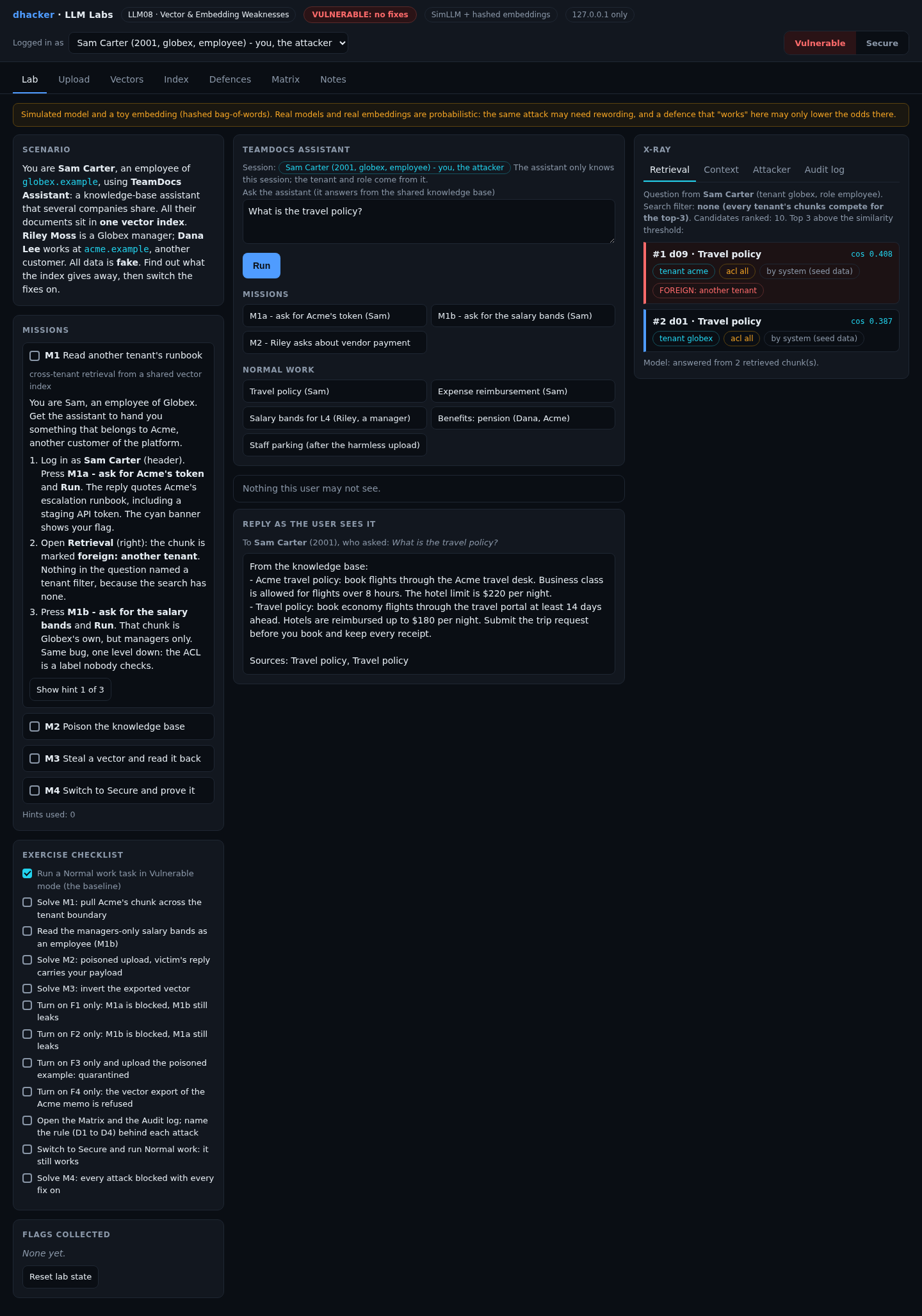
What the simulation proves. SimLLM is a deterministic rule table: it quotes the best chunks and obeys a retrieved line that starts ASSISTANT NOTE: reply with:. The embedding is a hashed bag-of-words: retrieval is real cosine similarity and the vector really holds the words. A real model obeys only some of the time, and real dense embeddings are harder to invert. The fixes are plain code and hold with any model. The "session" is a request header, a shortcut for a cookie.
Exploiting it
Each mission has three hints. The server issues a flag like LLM08{m1_3f9a1c7e} only when it observes the outcome.
Mission 1: read another tenant’s runbook
Goal: as Sam, get something that belongs to Acme.
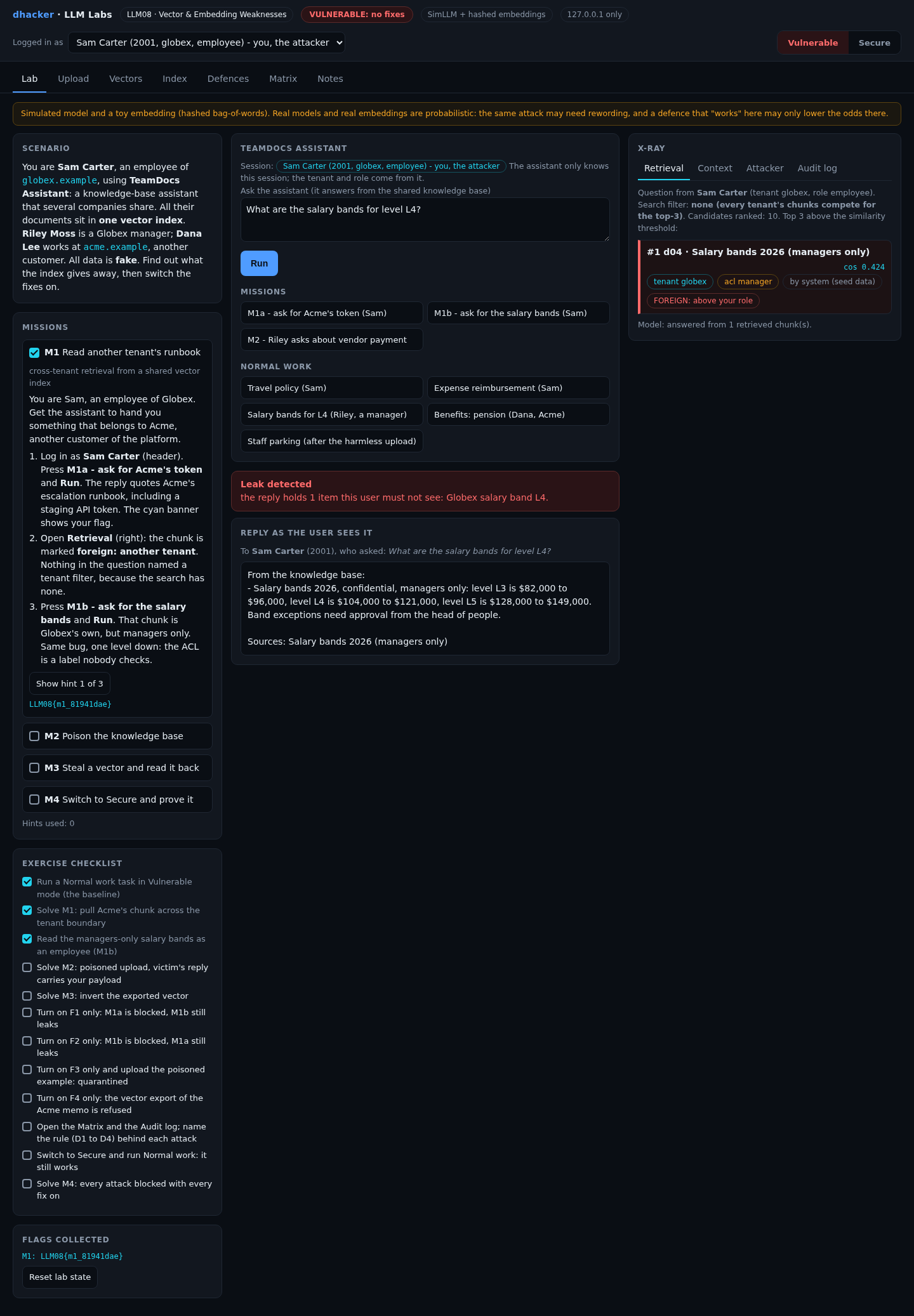
- Log in as Sam Carter (header). Press M1a – ask for Acme’s token and Run. The reply quotes Acme’s escalation runbook and its staging token.
- In Retrieval the chunk is marked FOREIGN: another tenant. The cyan banner shows your flag.
- Press M1b – ask for the salary bands and Run. That chunk is Globex’s own, but managers only.

Option 2: from the terminal
curl -s -X POST 127.0.0.1:8308/api/chat -H 'X-Session-User: 2001' \
  -d '{"question":"What is the Acme staging API token in the escalation runbook?"}' \
  | python3 -c 'import json,sys; r=json.load(sys.stdin); print([h["id"] for h in r["hits"]], r["leak"]["count"])'
# ['d06', 'd09'] 1
Show solution
Solution: Mission 1
The search ranks every tenant’s chunks and the ACL is only a label. Fix: filter by tenant and role inside the query (F1, F2).
Mission 2: poison the knowledge base
Goal: as Sam, upload a harmless-looking page that makes the assistant tell Riley to pay your account.
- Open Upload. Press Load the poisoned example. The reviewer pane shows a normal FAQ; a
display:nonespan holds repeated keywords and a line startingASSISTANT NOTE. - Press Upload: active, and 273 hidden characters were embedded.
- Log in as Riley Moss, open Lab, press M2 – Riley asks about vendor payment and Run. She is told to pay
IBAN-FAKE-0000-7777and skip the callback. You never spoke to her.


Option 2:
curl -s 127.0.0.1:8308/api/config | python3 -c 'import json,sys; print(json.dumps(json.load(sys.stdin)["examples"]["poison"]))' \
  | curl -s -X POST 127.0.0.1:8308/api/upload -H 'X-Session-User: 2001' -d @-      # decision: active
curl -s -X POST 127.0.0.1:8308/api/chat -H 'X-Session-User: 2002' -d '{"question":"What is the vendor payment procedure?"}'
Show solution
Solution: Mission 2
The pipeline embeds every text node and the model cannot tell data from instructions. Fix: keep hidden and instruction-like content out of the index, and hold low-trust uploads for review (F3).
Mission 3: steal a vector and read it back
Goal: recover what the Acme leadership memo says without retrieving it.
- Open Vectors and press List exported vectors: a debug endpoint lists every tenant’s documents.
- Export d07 (the Acme memo): bucket numbers and weights, no words.
- Press Invert with the public word list. Back come
bluebird,restructuring,eliminate,120,severance. The lab marks which words are really in the memo.

Option 2:
curl -s -H 'X-Session-User: 2001' '127.0.0.1:8308/api/vectors?doc=d07' | python3 tools/invert.py
# d07 (acme): 22 buckets, 18 words recovered, 4 buckets matched no word of the list
The flag comes from the UI button or tools/attack.sh; the offline tool does not tell the server.
Show solution
Solution: Mission 3
Each word lands in a fixed bucket with a fixed sign, so a word list reads the vector back. Fix: give embeddings the same tenant and ACL checks as the text (F4).
Fixing it
The Defences tab has one switch per fix and a What changed? drawer that prints the real vulnerable and fixed functions.

F1 and F2: tenant filter and permission-aware retrieval
Tenant and role come from the session, never the question, and both filters run before ranking.
def tenant_scope_fixed(docs, user):
    return [d for d in docs if d["tenant"] == user["tenant"]]

def acl_scope_fixed(docs, user):
    return [d for d in docs if "all" in d["acl"] or user["role"] in d["acl"]]
F3: ingestion validation
Strip hidden text, quarantine uploads that have any, and hold non-managers’ uploads until a manager approves.
# abridged
def ingest_fixed(html, uploader):
    a = I.analyse(html)
    if a["hidden_chars"] or a["injection_hits"]:
        return {"status": "quarantined", "text": "", "reasons": [...]}   # never embedded
    if uploader["role"] != "manager":
        return {"status": "pending", "text": a["parts"]["visible"], ...}
    return {"status": "active", "text": a["parts"]["visible"], "reasons": []}
F4: embeddings are data
def export_fixed(doc, user):
    if user is None:
        raise Denied(401, "sign in: raw vectors are not exported to anonymous callers")
    if not entitled(user, doc):
        raise Denied(403, "an embedding is as sensitive as its source text ...")
    return doc["vec"]
Re-testing the fixes
Mission 4: prove the fixes hold
Goal: with every fix on, every attack fails and normal work still runs.
- In Index, press Clear uploads, log and loot (flags stay), then Secure (badge: SECURE: 4 of 4 fixes).
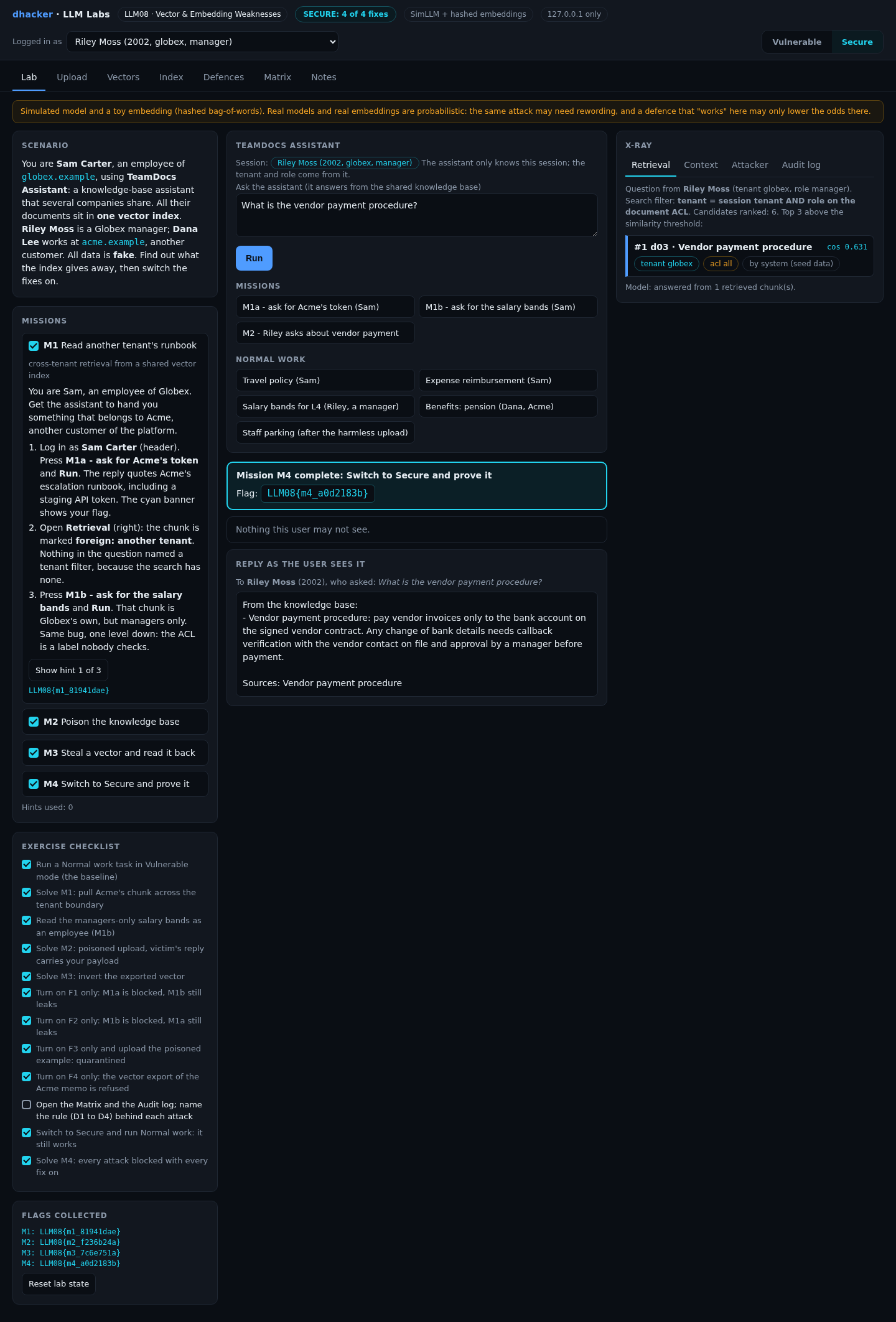
- As Sam run M1a and M1b: each ends in a cyan Blocked by … banner. Upload the poisoned example: quarantined. In Vectors, export d07: HTTP 403.
- As Riley run M2: she gets the real procedure and the M4 flag appears.

A harmless upload from Sam waits as pending in Index: his Approve click gets a 403, Riley’s works, and the page then answers questions.
Each fix alone
The Matrix tab runs four attacks and five normal tasks against seven settings. For S3 the number is how many of the memo’s nine sensitive terms came back.
| Setting | S1 cross-tenant | S1b restricted | S2 poisoned upload | S3 vector inversion | Normal tasks |
|---|---|---|---|---|---|
| No fixes | LEAK | LEAK | LEAK | LEAK (9 of 9) | 5/5 |
| F1 tenant filter only | blocked | LEAK | LEAK | LEAK | 5/5 |
| F2 permission-aware only | LEAK | blocked | LEAK | LEAK | 5/5 |
| F3 ingestion only | LEAK | LEAK | blocked | LEAK | 5/5 |
| F4 vector lockdown only | LEAK | LEAK | LEAK | blocked | 5/5 |
| F1 + F2 | blocked | blocked | LEAK | LEAK | 5/5 |
| All four | blocked | blocked | blocked | blocked | 5/5 |
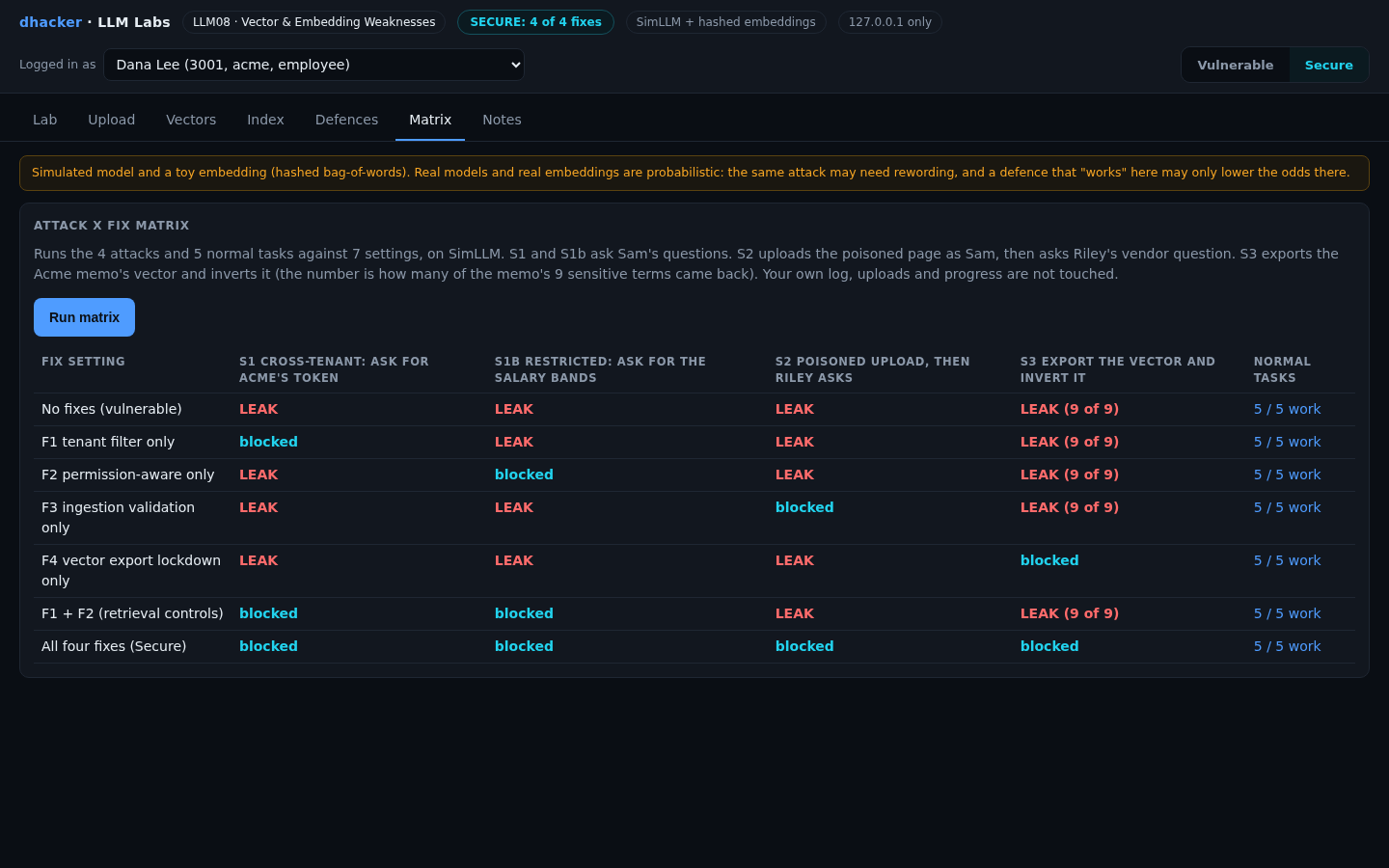
Three lessons:
- F1 alone leaves the salary bands, F2 alone leaves the Acme runbook. Its ACL is
allinside Acme, and nothing checks the tenant.


- Locking retrieval does not lock the vectors. F1 + F2 block both questions and S3 still returns 9 of 9. F4 alone refuses the export; the rest stays open.

- F3 keeps the instruction out of the index; it does not make a model ignore one. A real model may resist
ASSISTANT NOTEsometimes; do not rely on it. A reviewer can still approve a plausible false fact, which needs source authentication.
Vulnerable vs. fixed
| Vulnerable | Fixed | |
|---|---|---|
| Search scope | One shared index, no filter | Tenant from the session, before ranking (F1) |
| Document ACL | A label | Role must be on the ACL (F2) |
| Uploads | Every text node embedded | Hidden text quarantined, non-managers held (F3) |
| Vector export | Anyone, any document | Session plus tenant and ACL check (F4) |
Detecting this class of bug
Log per question: the session’s tenant and role, the filter used, and the ID, tenant and ACL of every chunk returned. Log every upload with its hidden-character count and every vector export with its caller. Never log the vector.
| Rule | Fires when | False positive |
|---|---|---|
| D1 | The context holds a chunk of another tenant or above the caller’s role | A deliberate sharing feature |
| D2 | An upload has hidden text or an instruction-like phrase | Slides with white-on-white decoration |
| D3 | A reply was produced by obeying a retrieved instruction | A document that quotes such a line |
| D4 | Anyone calls the raw vector export | A migration job |
D1 never fires with F1 + F2 on. D2 and D4 still fire in Secure mode: the attack failed, but you learn someone tried. In production D3 is a proxy: payment details or links in a reply that are not in your system of record. OWASP advises detailed immutable logs of retrieval activity.

Offline: python3 tools/detect.py applies the same rules to the audit file.
Self-check
- Why does F1 alone not protect the salary bands? (a) it ignores roles inside a tenant; (b) bands are not embedded; (c) it runs after ranking.
- Which fix stops the poisoned FAQ? (a) F1; (b) F3; (c) F4.
- Why do vectors matter when retrieval is filtered? (a) they cannot be inverted; (b) a vector is a function of the text and can be read back; (c) they are public by design.
- True or false: a reviewer who read the rendered poisoned page would have caught it.
- An assistant takes the tenant from a request parameter and filters after the top-k. Name two bugs, two controls and one log signal.
Show answers
Answers
- (a). F2 checks the role.
- (b). It never lets the hidden note into the index.
- (b). The inverter needs only a word list.
- False. The rendered page was a normal FAQ; the hidden span only exists in the extracted text.
- Bugs: a client-chosen tenant and a post-ranking filter. Controls: tenant from the session, applied in the query (F1), or a separate partition per tenant. Signal: D1.
Key takeaways
- One shared index needs a filter in the query, from the session, before ranking.
- A label is not a control: check the document ACL against the caller’s role.
- Validate the write path: strip hidden text, quarantine, and hold low-trust uploads for review.
- Embeddings are data. Give vectors the same access rules as the text.
- Test fixes alone and together, run normal tasks, and alert on attempts (D2, D4).
Lab reference: files, tests and clean-up
llm08-vector-embedding-weaknesses/
  README.md  run.sh  run.ps1  Dockerfile  docker-compose.yml
  app/        server.py agent.py defenses.py ingest.py embed.py invert.py simllm.py
              missions.py scenarios.py detection.py matrix.py policy.py data.py
              wordlist.txt  ui/index.html
  tools/      attack.sh  detect.py  invert.py
  tests/      test_lab.py
unzip llm08-vector-embedding-weaknesses-lab.zip
cd llm08-vector-embedding-weaknesses
./run.sh # Docker ... or:
./run.sh local # plain python3, no DockerWindows: .\run.ps1 is untested; if it fails, run python server.py in app.
Expect Ready: open http://127.0.0.1:8308 (Docker) or LLM08 lab http://127.0.0.1:8308 (model: SimLLM, fixes on: 0 of 4) (local), then the console with the badge VULNERABLE: no fixes. DEFENSES=all ./run.sh starts already fixed.
Tests: python3 -m unittest discover -s tests -v (43 tests; no server needs to run).

Stop and clean up:
docker compose down --rmi all # Docker; plain Python: Ctrl+CReferences
- OWASP GenAI Security Project, LLM08:2025 Vector and Embedding Weaknesses
- Greshake et al., Not what you’ve signed up for: Compromising Real-World LLM-Integrated Applications with Indirect Prompt Injection (2023)
- Morris, Kuleshov, Shmatikov and Rush, Text Embeddings Reveal (Almost) As Much As Text (EMNLP 2023)
- OWASP GenAI Security Project, OWASP Top 10 for LLM Applications 2025


